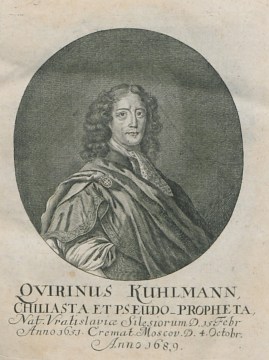
© British Library (General Reference Collection 1229.h.4., unnumbered page). The image has been cropped.
Quirinus Kuhlmann (1651-1689) was born in the Silesian city of Breslau and attended one of its two famous grammar schools, where he distinguished himself not only as a scholar, but also as a poet. In the throes of a serious illness, he had visions which suggested to him that he had been called for a special God-given purpose. He matriculated at the University of Jena, where his haughty and peculiar behaviour seems to have set him apart from his fellow students. He continued his studies at the University of Leiden in the Netherlands, where he devoured the works of a Lusatian thinker, Jacob Boehme (1575-1624), whose theosophy was to become very important for Kuhlmann’s understanding of his own mission and identity.
Kuhlmann the author
In 1674 Kuhlmann’s view of himself as the inheritor of Boehme’s vision was published as Neubegeisterter Böhme (Böhme Newly Inspired), in which he claims to answer more than one billion theosophical questions. This was by no means Kuhlmann’s first work: he had already published both poetry and prose, and he would go on to author a number of other texts, both under his own name and under pseudonyms such as Cyrus Refrigeratorius or Salomon a Kaiserstein, publishing in Dutch and English, as well as in German and Latin. His most striking work is his poetry anthology, Der Kühlpsalter (1684-86), a highly accomplished collection which catalogues his travels, offering interpretations of them in the context of significant European events and in the light of his own developing millenarian world-view.
Kuhlmann in London
After leaving Leiden, Kuhlmann went to Amsterdam and Lübeck, before embarking for London, where he arrived on Maundy Thursday 1676. His main contacts here were with nonconformist conventicles, and he numbered Quakers and Philadelphians amongst his acquaintances. He found a patron in John Bathurst, a wealthy gentleman, who provided him with accommodation and funded some of his travels. For Kuhlmann, London was a ‘wonderland’, and he visited it a number of times over a period of several years, spending considerable time in the city. He also found an English wife in the person of Mary Gould, known in his writings as ‘Maria Anglicana’, whom he appears to have married in Amsterdam.
Kuhlmann the millenarian
In Leiden Kuhlmann had come into contact with Johann Rothe, a Dutch prophet who had spent time in England and had been in contact with the radical Fifth Monarchy Men, a politico-religious group who, during the Civil War and Interregnum, had predicted the imminent rise of fifth and final world monarchy which would precede the end of the world. Rothe had visions of a youth sent by God, and he identified Kuhlmann as this figure. Kuhlmann would later describe Rothe as his John the Baptist. The persona of the chosen youth eventually developed into an identity as ‘Jesuel’, the son of the Son of God, who would rule over a cooling-monarchy before the end of the world. This refers both to the Old Testament vision of the four earthly kingdoms that would give way to a fifth godly kingdom (Daniel 2 and 7) and to a New Testament passage about a time of cooling or refreshing (Acts 3), which Kuhlmann applied to himself because of the connection with his surname. He considered his ministry to have been foretold by three central European prophets: Kryštofer Kotter, Mikuláš Drabík and Krystyna Poniatowska, whose visions had been collected and published by Jan Amos Komenský (Comenius), and he tried to fit the events of his own life to these prophecies, regarding the three as his ‘Cool-prophets’.
Kuhlmann’s travels
Kuhlmann travelled throughout Europe and further afield as part of his mission, spending longer periods in Britain, France and the Netherlands en route. In 1678 he set out for Turkey, where he intended to convert the Sultan to Christianity, but he was sent packing. He also attempted to travel to Jerusalem, although he only reached Lake Geneva, and from there journeyed to Jerusalem in visions. In 1689 he set off on his last journey to Moscow, where the enmity of the local Lutheran minister in the German enclave of the city, together with volatile political struggles within the Russian royal family, combined to send him to a heretic’s death, together with an acolyte, Konrad Nordermann, in October 1689.
 German Writers in Stuart Britain