370 years ago, on the afternoon of January 30th 1649 (Old Style), Charles I mounted the scaffold erected outside the Banqueting House at the Palace of Whitehall, and was beheaded in front of crowds of his subjects. The execution of a divinely ordained monarch sent shock waves across Europe. Eikon Basilike, a collection of meditations supposedly written by the monarch during his imprisonment, was rapidly published in German, as well as other European languages, and German presses saw an outpouring of printed material: engravings, poems, tracts, and longer historical accounts. Here are three examples.

The north German poet and hymn writer Johann Rist styled himself Tirsis, shepherd of the Thames, to publish his lament entitled ‘Bloody Tears’, written a year after the execution. The 57-strophe poem — not, it must be admitted, one of Rist’s better efforts — is followed by eighteen pages of explanatory notes, in which he provides his readers with copious details about the fascinating Stuarts and recent events in the British Isles, which he notes, were quite literally better than a play:
‘Der jenige/ welcher in den Geschicht=Büchern etwas ist bewandert/ wird nebenst mir müssen bekennen/ daß wol kein Christliches Königreich unter der Sonnen zu finden/ in welchem so viele blutige Schawspiele/ als in Engelland gesehen worden. ‘
Anyone who knows their way around history books will surely agree with me that there is no Christian kingdom under the sun which has seen so many bloody dramas as England. (Blutige Thränen/… (n.p.: n.pub., 1650), p. 23.)
Rist’s friend Georg Greflinger, and a younger fellow Hamburg writer, Eberhard Werner Happel, dedicated entire publications to the Stuarts. Greflinger was, in fact, so struck by the unprecedented regicide that he published a number of poems, including a dialogue in which Charles speaks in dignified Alexandrines, and Cromwell utters his words — most incongruously — in swaggering, villainous dactyls. Here are the opening strophes, where the divine right of kings and godless republicanism clash:
König. ¦ Ey Cromwel zäume dich du bist mein Vnterthan ¦ greiff deinen König nicht mit solcher Boßheit an ¦ kennstu den Himmel nicht/ der alles rächen kan?
Cromwel. ¦ Was Himmel! Was Hölle! was König was Knecht! ¦ Jch führe den Degen und gebe das Recht. ¦ Jch schlage den König vnd Königs Geschlecht.
King: Cromwell, desist, you are my subject; do not lay evil hands upon your king. Have you no fear of Heaven’s vengeance? Cromwell: Who cares for Heaven, Hell, king or servant! I wield the dagger and lay down the law. I strike at the king and the royal line. (Gesprächlied zwischen dem König von Engeland und Cromweln (Hamburg: [n.pub.], 1651), [fol. 1v].)
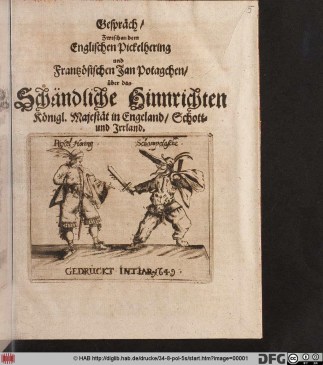
The final publication illustrated here is another dialogue, but this one is in prose and does not include the main protagonists of the action. Rather it is a conversation between two fools, the French Jean Potage and the English Pickleherring, a comic figure imported from the English travelling players of the early seventeenth century. But the subject matter is anything but comic, and Pickleherring gives full voice to his moral outrage and fears for England’s reputation abroad:
[E]ine grausame That! Ja vnter Christen Menschen in keiner Chronik niemahls beschriebene That… O Schand über alle Schande! O Laster über alle Laster! O Greuel über alle Greuel.
A terrible deed! A deed, indeed, never recorded in chronicles of Christian peoples … Oh shame above all shame! Oh wickedness above all wickedness! Oh horror above every horror. (Gespräch zwischen dem Englischen Pickelhering und Frantzösischen Jan Potagchen … (n.p.: n.pub., 1649), fol. A2r.)
For a detailed discussion of the reception of the execution in German texts, see Günter Berghaus, Die Aufnahme der englischen Revolution in Deutschland 1640-1669: Studien zur politischen Literatur und Publizistik im 17. Jahrhundert mit einer Bibliographie der Flugschriften (Wiesbaden: Harrassowitz, 1989).
 German Writers in Stuart Britain